Posts

Showing posts with the label Castrol

Crankshafts

Image
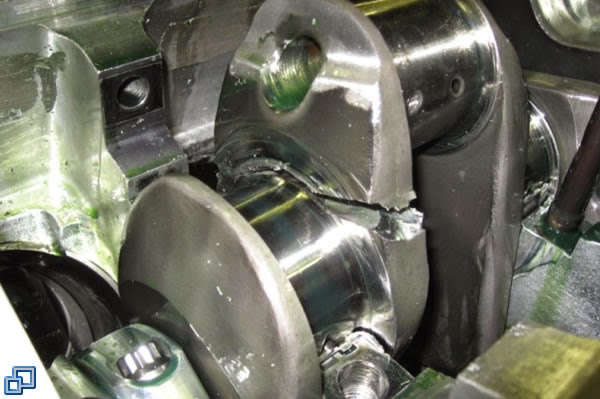
Your crankshaft goes from 0 to 3000 rpm in about two seconds. When the air fuel mixture expands in the cylinder head it forces the piston and connecting rod down into the crankshaft. At 8,000 rpm it does this 4,000 times a minute. The  crankshaft only appears to be rigid. It isn't. Anytime a load is applied to a part the part deflects. All  parts ultimately act as a spring in response to a load. In the case of the crankshaft that movement will be very small but it will be intense. It will also happen very quickly. When the engineers designed your engine they did a lot of calculations and they created a crankshaft that could withstand all of these forces. Now decades later you’re changing everything. You’re trying to get more horsepower out of your old engine, which blows up all those original calculations. You’re applying a lot more stress than the designer ever envisioned. And, you’re asking a fifty-year old part to do this. Maintenance Schedule: Tom Lieb, founder of Scat Cra...

Exhaust Headers

Image
All of our cars have exhaust manifolds. Some of us are even using the stock manifold that came on the car when it was new. Others have spent thousands of dollars on the latest and greatest header system. Before you get your checkbook out you need to think about a few things. Am I spending all this money to go faster? Or, am I concerned about what people think when I open the hood? Maybe it’s a little bit of both. Materials: We have a number of choices here. About eighty per cent of all aftermarket headers are coated mild steel. Stainless steel though is becoming a popular replacement material for exhaust headers. Just keep in mind that not all stainless is the same. The folks at Burns Stainless point out that technically, Stainless Steel is a trade name applied to what are known as corrosion-resistant steels. They believe that “It is a fabulous material that outperforms mild and alloy steels in so many different applications in racing that no other material can match it.” A three-digi...

FIA Historic Rules

Image
Is Historic racing about racing vehicles as they existed when they were contemporary or is it just an opportunity to race old cars? Vintage racing has been a great example of technological creep. At one time a 1969 Porsche 2.0 911 was limited by 1969 technology. Today that 1969 Porsche 911 is reaching speeds never imagined by the original designers. It didn’t happen all at once. It evolved over the years. First it was the adjustable shocks, and then came the MSD ignition box followed by wider wheels. Each one of those items was insignificant. But as the technological creep moved on the cars got faster, the costs got higher and the car count got smaller.   The FIA, or Federation Internationale de l'Automobile, has a set of rules for historic racing cars and these rules don’t change every year. Historic racing cars in most of the world must have FIA papers in order to compete at larger events (plus some selected smaller ones too). These rules provide an internationally accepted set ...

Gauges

Image
Everyone one can see your gauges when you’re parked in the paddock. With the renewed emphasis on period correct appearance a set of Auto Meter gauges will seriously jeopardize your credibility. You may be able to hide those 6-piston calipers behind your steel wheels but you sure can’t have an Auto Pro tachometer with that giant shift light. Everyone can see that. Cobra Worse yet everyone knows that no one used a shift light in their 1960 MGA. In addition to looking period correct though you also want your gauges to work properly. Fifty-year-old gauges can work properly and maintain the period correct look. When our cars were actively raced no one cut up the dash to install fancy gauges. We used the gauges that came with the car. Actually most of us were too poor to afford aftermarket gauges. At any rate these gauges worked just fine back then and they should still work today.    There are two items we need to consider. Gauges need to be both reliable and accurate. Reliabilit...