Posts

Showing posts with the label FIA

Crankshafts

Image
Your crankshaft goes from 0 to 3000 rpm in about two seconds. When the air fuel mixture expands in the cylinder head it forces the piston and connecting rod down into the crankshaft. At 8,000 rpm it does this 4,000 times a minute. The  crankshaft only appears to be rigid. It isn't. Anytime a load is applied to a part the part deflects. All  parts ultimately act as a spring in response to a load. In the case of the crankshaft that movement will be very small but it will be intense. It will also happen very quickly. When the engineers designed your engine they did a lot of calculations and they created a crankshaft that could withstand all of these forces. Now decades later you’re changing everything. You’re trying to get more horsepower out of your old engine, which blows up all those original calculations. You’re applying a lot more stress than the designer ever envisioned. And, you’re asking a fifty-year old part to do this. Maintenance Schedule: Tom Lieb, founder of Scat Cra...

Safe Seating

Image
If your seat breaks up in a crash your belts and roll cage are totally useless. Your seat is the primary element in your safety system. A lot of effort has gone into both the design and the materials used to create new, and safer, seats. It’s no longer about the look. It’s all about being safe in a crash. There are two items of concern. First, we have the issue of the seat itself. Then we have the issue of how this seat is mounted. Even the best seat is useless if it rips out of the floor. One thing is not more important than the other. A great seat does no good unless it’s mounted correctly. In vintage racing a great deal of attention is paid to the construction of the roll cage and the age of the seat belts. When it comes to seats too many sanctioning groups allow just about anything that looks nice. A brand new 6-point harness won’t do you much good if your seat breaks up in a crash. The various sanctioning groups need to start paying more attention to seats. Certification It’s real...

Valve Train

Image
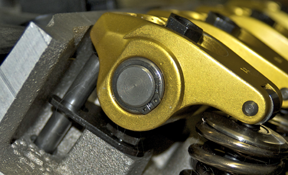
It’s all about the rpms. If our engines turn 7,500 rpm we would love to get to 8,000. If we run 8,000 down the back straight we want to get to 9,000 rpm. Every additional 1,000-rpm may be worth an extra 20 or more horsepower on a highly modified performance motor.     Spin an engine faster and it will, in most cases, make more power. The standard example is F1. Today’s F1 engines make roughly the same amount of power as they did 10 years ago – at 10,000 rpm. The difference is that today they go to 18,000 rpm. The additional horsepower comes from increased rpms. Increased rpms come from stabilizing the valve train. Most of the vintage cars in the paddock use pushrods and rocker arms in the valve train. In the United States we have a huge industry focused on making overhead valve engines with pushrods perform better. Everything NASCAR does is dedicated to this technology. Can an MGA benefit from what they’re doing in NASCAR? Of course.   Your MGA has the same basic valve ...