Posts

Heim Joints

Image
When the British shot down a German plane in early 1940 they found a rather interesting connection in the aircraft's control system. This unique connection was what we’ve come to call a spherical rod end. In the UK the patent was given to Rose B earings Ltd .   That’s why British call them Rose Joints. In North America the H.G. Heim Company was given an exclusive patent to manufacture these joints. That’s why in the United States we call them Heim Joints. They’re the same thing.                         High quality economical spherical rod ends really didn’t appear until the late 1970s. A Japanese company, N.M.B, produced these spherical rod ends. The reason they were so economical was that they were selling them for less than it cost them to manufacture them. The United States government asked them to please leave the marketplace so they purchased a U.S. company, N.H.B.B....

Exhaust Headers

Image
All of our cars have exhaust manifolds. Some of us are even using the stock manifold that came on the car when it was new. Others have spent thousands of dollars on the latest and greatest header system. Before you get your checkbook out you need to think about a few things. Am I spending all this money to go faster? Or, am I concerned about what people think when I open the hood? Maybe it’s a little bit of both. Materials: We have a number of choices here. About eighty per cent of all aftermarket headers are coated mild steel. Stainless steel though is becoming a popular replacement material for exhaust headers. Just keep in mind that not all stainless is the same. The folks at Burns Stainless point out that technically, Stainless Steel is a trade name applied to what are known as corrosion-resistant steels. They believe that “It is a fabulous material that outperforms mild and alloy steels in so many different applications in racing that no other material can match it.” A three-digi...

Valve Train

Image
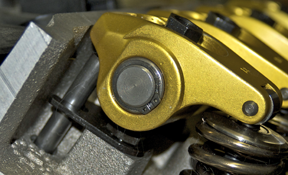
It’s all about the rpms. If our engines turn 7,500 rpm we would love to get to 8,000. If we run 8,000 down the back straight we want to get to 9,000 rpm. Every additional 1,000-rpm may be worth an extra 20 or more horsepower on a highly modified performance motor.     Spin an engine faster and it will, in most cases, make more power. The standard example is F1. Today’s F1 engines make roughly the same amount of power as they did 10 years ago – at 10,000 rpm. The difference is that today they go to 18,000 rpm. The additional horsepower comes from increased rpms. Increased rpms come from stabilizing the valve train. Most of the vintage cars in the paddock use pushrods and rocker arms in the valve train. In the United States we have a huge industry focused on making overhead valve engines with pushrods perform better. Everything NASCAR does is dedicated to this technology. Can an MGA benefit from what they’re doing in NASCAR? Of course.   Your MGA has the same basic valve ...